




Consensual non-monogamy (CNM) is any relationship where every partner knows about and agrees to romantic or sexual involvement with other people. That covers swinging, open relationships, polyamory and the hotwife dynamic. Plenty gets written about it. Very little of that writing checks the numbers. So we went back to the peer-reviewed studies and the national polls, opened each one, and kept only the figures we could verify at the source.
Key findings
- No satisfaction gap. A 2025 meta-analysis of 35 studies (24,489 participants) found that monogamous and non-monogamous people report the same levels of relationship satisfaction and sexual satisfaction (Anderson et al., Journal of Sex Research).
- Roughly 1 in 5 have tried it. In two US national samples of single adults, 21.9% and 21.2% said they had been in a CNM relationship at some point in their lives (Haupert et al., 2017).
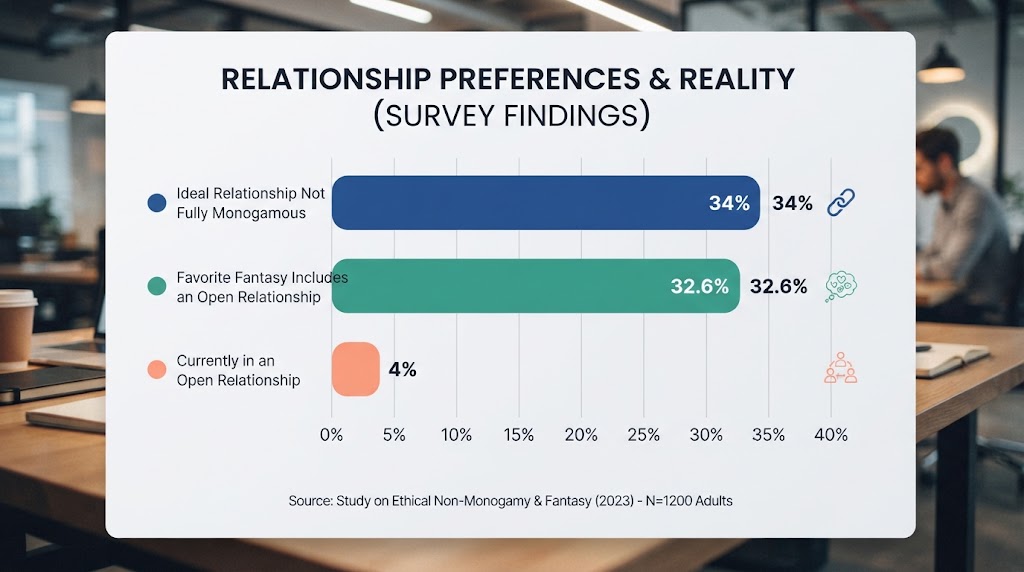
- Far fewer are doing it right now. Only 4% of US adults in the 2012 National Survey of Sexual Health and Behavior reported an open relationship (Levine et al., 2018). In Canada the figure was 2.4% of all adults (Fairbrother et al., 2019).
- The fantasy is far more common than the practice. Among 822 people in monogamous relationships, 32.6% said a sexually open relationship was part of their favorite sexual fantasy of all time (Lehmiller, 2020).
- The public still disapproves. In a February 2023 YouGov poll, more Americans disapproved than approved of open relationships (net −26), polyamory (−31) and swinging (−35) (YouGov, 2023).
How many people have actually practiced consensual non-monogamy?
It depends on whether you ask “ever” or “right now,” and the gap between those two answers is the most misunderstood number in this whole field.
The most-quoted figure comes from Kinsey Institute researchers Haupert, Gesselman, Moors, Fisher and Garcia. Their 2017 paper in the Journal of Sex & Marital Therapy drew on two Census-based quota samples of single US adults (3,905 and 4,813 people). In both, just over one in five said they had engaged in CNM at some point. That share held steady across age, income, education, religion, region, politics and race. It differed only by gender and sexual orientation: men and lesbian, gay and bisexual respondents were more likely to report it.
Current participation is much smaller. Levine, Herbenick and colleagues analyzed 2,270 adults from the nationally representative 2012 National Survey of Sexual Health and Behavior: 89% reported monogamy, 4% an open relationship, and 8% non-consensual non-monogamy (cheating). Read that again. In that sample, cheating was twice as common as open relationships.
Canada gives similar numbers. Fairbrother, Hart and Fairbrother surveyed a nationally representative sample of 2,003 Canadian adults in 2017. They found 2.4% of all participants, and 4.0% of those in a relationship, were in an open relationship at the time. One-fifth reported having been in one before.
CNM prevalence at a glance
| Measure | Figure | Population / sample | Source |
|---|---|---|---|
| Ever engaged in CNM | 21.9% / 21.2% | US single adults; n = 3,905 and 4,813 | Haupert et al., 2017 |
| Ever engaged in polyamory | 10.7% (1 in 9) | US single adults; N = 3,438 | Moors et al., 2021 |
| Ever in an open relationship | One-fifth | Canadian adults; N = 2,003 (2017) | Fairbrother et al., 2019 |
| Currently in an open relationship | 4% | US adults; n = 2,270 (2012 NSSHB) | Levine et al., 2018 |
| Currently in an open relationship | 2.4% of all; 4.0% of partnered | Canadian adults; N = 2,003 | Fairbrother et al., 2019 |
| Ever had sex with someone else, with main partner’s consent | 12% (2023); 11% (2025) | US adult citizens; n = 1,000 and 1,125 | YouGov 2023; YouGov 2025 |
| Ever had sex with someone else, without consent | 20% (2023); 25% (2025) | US adult citizens | Same as above |
| Ever been in a polyamorous or open relationship | 9% | US adult citizens; n = 1,125 (April 2025) | YouGov 2025 |
What this means: The “1 in 5” figure is real, but it describes lifetime experience among single adults, not how many couples are open today. Critics, including Charles Fain Lehman at the Institute for Family Studies, have pointed out that a singles-only sample may not generalize to married people (IFS, 2019). The honest summary: somewhere between one in ten and one in five adults has tried some form of CNM, and roughly 2% to 4% are in an open arrangement at any given time.
How many people want a non-monogamous relationship?
Interest runs well ahead of practice, and it’s concentrated among younger adults and men.
YouGov asked Americans to rate their ideal relationship from 0 (completely monogamous) to 6 (completely non-monogamous). In February 2023, 55% chose complete monogamy and 34% chose something else. In 2016 the share choosing complete monogamy was 61%. In the April 2025 version, 28% of Americans placed their ideal somewhere off full monogamy.
Age and gender split hard. In the 2023 poll, only 35% of men aged 18 to 44 picked complete monogamy, while 74% of women 45 and older did.
Asked directly, 14% of Americans in April 2025 said they would definitely (4%) or probably (10%) consider an open or polyamorous relationship. Men were more than twice as likely as women to say so (20% vs. 9%).
The academic samples land in the same zone. Moors, Gesselman and Garcia found that 16.8% of single US adults (about 1 in 6) want to try polyamory specifically. In Canada, Fairbrother’s team found 12% named an open relationship as their ideal type, with younger adults and men more likely to say so.
What draws people in, and what keeps them out?
YouGov’s 2025 poll asked both groups for their reasons:
| Reason | Share citing it |
|---|---|
| Among those open to CNM: desire to have different needs fulfilled | 58% |
| Desire for more sex | 49% |
| Desire for more variety | 48% |
| Desire for more emotional or intimate connection | 47% |
| Among those not open to CNM: moral opposition | 50% |
| Lack of interest | 50% |
| Jealousy | 34% |
| Lack of emotional capacity | 27% |
Source: YouGov, April 18–21, 2025, n = 1,125 US adult citizens.
The detail worth noticing: “issues with current partner” was cited by only 20% of those open to CNM. Most people who are curious aren’t trying to escape a failing relationship. They want more of something.
How common are fantasies about open relationships?
Fantasy is where the numbers get big.
Justin Lehmiller of the Kinsey Institute studied 822 people who were currently in monogamous relationships (Archives of Sexual Behavior, 2020). Nearly one-third (32.6%) said being in some type of sexually open relationship was part of their favorite sexual fantasy of all time. Of those, 80% said they wanted to act on it. A majority of the full sample said they had fantasized about a CNM relationship at least once, and open relationships were the most popular variety.
Two findings from that paper matter for couples:
- People who had already shared or acted on these fantasies generally reported positive outcomes, meaning the experience met or exceeded expectations and improved their relationships.
- The predictors of CNM fantasies differed from the predictors of infidelity fantasies, which suggests they’re driven by different psychology. Wanting an open arrangement is not the same impulse as wanting to cheat.
One caution: this was a large online sample, not a nationally representative one. The people who shared their fantasies and reported good outcomes chose to share them, so their results can’t tell you how a random couple would fare.
Are non-monogamous couples less satisfied?
No. This is the strongest finding in the research, and it’s also the one most often ignored.
In March 2025, a team led by Associate Professor Joel Anderson of La Trobe University’s Australian Research Centre in Sexuality, Health and Society published a meta-analysis in the Journal of Sex Research, titled “Countering the Monogamy-Superiority Myth.” They pooled 35 studies covering 24,489 people. The results:
- Relationship satisfaction: no meaningful difference (29 studies; g = −0.05, p = .496).
- Sexual satisfaction: no meaningful difference (17 studies; g = 0.06, p = .393).
- The null result held across LGBTQ+ and heterosexual samples, across open, polyamorous and “monogamish” arrangements, and across dimensions like trust, commitment and intimacy.
- The authors found no evidence of publication bias.
The authors flag their own limits: the underlying studies relied on online samples and self-reported data, and nearly all came from Western countries. Anderson’s explanation for the result is worth quoting. He suggests that because people in consensual arrangements have agreements with their partners, “infidelity isn’t a relevant factor in their relationships” the way it is for monogamous couples (Taylor & Francis release via Scimex, March 26, 2025). That’s a hypothesis, not a tested finding.
That confirms what earlier reviews suggested. Rubel and Bogaert’s 2015 review in the Journal of Sex Research concluded that people in swinging, open and polyamorous relationships showed similar psychological well-being and relationship quality to monogamous people. Conley, Matsick, Moors and Ziegler (2017, Perspectives on Psychological Science) likewise found few differences in relationship functioning.
The exceptions worth knowing about
The headline isn’t “CNM is always fine.” Some studies do find gaps, and they’re instructive.
| Study | Sample | Finding |
|---|---|---|
| Levine et al., 2018 | 2,270 US adults (2012 NSSHB) | People in open relationships reported lower relationship satisfaction than monogamous people. |
| Conley & Piemonte, 2021 | Three studies of CNM adults | Polyamorous and swinging couples reported higher satisfaction, trust and passionate love than people in open relationships. |
| Conley & Piemonte, 2021 (Studies 4–5) | Same | The open-relationship gap disappeared once researchers accounted for communication style, motivation for CNM, pro-monogamy beliefs and contact with partners’ other partners. |
| Fairbrother et al., 2019 | 2,003 Canadian adults | No significant satisfaction difference between monogamous and open relationships. People whose actual relationship type matched their preferred type were more satisfied. |
What this means: The structure itself doesn’t predict happiness. How couples run it does. Conley and Piemonte’s data point to the same suspects any couples therapist would name: how you communicate, why you’re doing it, and whether one of you secretly believes it’s wrong.
Do non-monogamous people feel less jealousy?
The research says they report less distress, not that jealousy vanishes.
Mogilski and colleagues (2019, Archives of Sexual Behavior) compared 529 monogamous and 159 CNM participants. Monogamous people reported greater emotional distress when imagining a partner’s outside involvement. CNM participants, by contrast, reported thinking about their partners’ other relationships more often. So they weren’t oblivious. They were just less distressed by it. Monogamous participants also engaged in more “mate guarding” behavior.
An earlier study by the same lab (Mogilski et al., 2017) compared 123 monogamous and 76 CNM participants. Overall relationship satisfaction didn’t differ between monogamous partners and CNM primary partners. But monogamous participants were less satisfied with the communication and openness in their relationship than CNM participants were with their primary partner.
Jealousy also remains the main thing keeping people out. In the 2025 YouGov poll, 74% of Americans said they would not be OK with a partner wanting sex with someone else. Among those who wouldn’t consider CNM, a third (34%) named jealousy as a reason.
If you’ve read our guide to compersion, you’ll recognize the pattern. Compersion doesn’t replace jealousy. It sits alongside it, and the couples who do well are the ones who talk through both. Our explainer on cuck angst covers the anxious side of the same coin.
How much stigma do non-monogamous people face?
A lot, and internalized stigma is linked to worse relationship outcomes.
Public opinion. YouGov’s February 2023 poll measured net approval (approve minus disapprove) for relationship styles among consenting adults:
| Relationship style | Net approval, all US adults | Net approval, men 18–44 |
|---|---|---|
| Monogamy | +72 | +54 |
| Friends with benefits | +10 | +38 |
| Open relationship | −26 | +22 |
| Throuple | −29 | +1 |
| Polyamory | −31 | +2 |
| Swinging | −35 | +2 |
| Polygamy | −49 | −4 |
Source: YouGov, February 1–6, 2023, n = 1,000 US adult citizens, margin of error about ±3%.
By April 2025, 51% of Americans told YouGov they believed polyamory is morally wrong (56% of women, 45% of men).
How people judge CNM couples. In Grunt-Mejer and Campbell’s 2016 vignette study (375 participants), the monogamous couple was rated most favorably, then the polyamorous couple, with open and swinging couples tied behind them. The cheating couple was rated worst. The authors concluded that consent, more than exclusivity, drove people’s judgments.
Balzarini and colleagues (2018, N = 641) found that even CNM participants favored monogamous targets over CNM as a broad category, the so-called “halo effect” around monogamy. That effect faded when people rated their own relationship type separately. Swingers were perceived as the most promiscuous and as having the highest STI rates.
A 2025 study by Selterman, Bowen, Datwani and Moors went further. Participants rated characters in non-monogamous relationships as less ethical and their relationships as lower quality than identical monogamous characters. In a second experiment, a non-monogamous character who was killed in a story was judged more morally culpable for their own death.
Stigma even reaches the researchers. In Conley and colleagues’ 2017 paper, researchers presenting findings that favored polyamory were perceived as more biased than researchers presenting findings that favored monogamy.
Internalized stigma hurts relationships. Moors, Schechinger, Balzarini and Flicker (2021) studied 339 people in open, swinging or polyamorous relationships. Those with more personal discomfort about CNM, such as wanting to change their relationship style or seeing it as unnatural, reported lower satisfaction with their agreements, lower overall relationship satisfaction and lower commitment. Sexual satisfaction was not affected.
What this means for couples
Here’s my read of the data, as someone who spends a lot of time with both the research and the people living it.
First, curiosity is common, not a red flag. If about a third of people in monogamous relationships in Lehmiller’s sample had an open-relationship scenario in their favorite fantasy, then discovering that your partner has one is ordinary. Lehmiller’s finding that CNM fantasies and infidelity fantasies have different predictors matters here. A partner who raises the topic is doing the opposite of cheating.
Second, structure doesn’t decide whether you’ll be happy. The meta-analysis is clear: as a group, non-monogamous people are just as satisfied as monogamous ones. That isn’t a promise that opening up will improve your relationship. It means the structure alone won’t sink it. What does predict trouble, per Conley and Piemonte, is poor communication, doing it for the wrong reasons, and quietly believing monogamy is the “right” way. The Fairbrother data adds a simple test: are you in the relationship type you actually want? A mismatch in either direction costs you.
Third, consent is everything, and outsiders know it too. Even skeptical members of the public rate a consensual open couple above a couple where someone is cheating. If you’re unsure where that line sits, our piece on whether hotwifing counts as cheating walks through it.
Fourth, deal with the internal critic. Moors’ 2021 study suggests that the voice telling you this is unnatural does more damage than the arrangement itself. If that voice is loud, a CNM-literate therapist is a better investment than another rulebook. Here’s how to find one.
Fifth, choose your style on purpose. Swinging, open relationships, polyamory and hotwifing work differently, and the research treats them differently. If you’re still sorting out which one fits, start with our comparison of swinging vs. polyamory vs. hotwifing.

What the research can’t tell you yet
Every number above comes with limits. Read them before you quote anything.
- Correlation, not causation. Almost all CNM research is cross-sectional. It can show that CNM and monogamous people report similar satisfaction. It can’t show that opening a relationship causes any change, good or bad.
- Self-selection. People who stay in CNM may be the ones it works for. Those it didn’t suit may have returned to monogamy and dropped out of the CNM groups in these studies.
- Sampling. The most-cited prevalence data (Haupert 2017, Moors 2021) comes from quota samples of single adults connected to the dating company Match. Haupert’s data came from Match’s Singles in America survey (as the IFS critique notes), and Moors et al. disclose that Match helped design the full survey and funded data collection. Many satisfaction studies rely on online community samples.
- Definitions vary. “CNM,” “open,” “polyamory” and “swinging” aren’t measured the same way across studies, and polls ask different questions in different years. That’s why YouGov’s 2023 and 2025 figures differ.
- Dated data. The largest probability sample of open relationships in the US (NSSHB) was collected in 2012. Current US prevalence from a probability sample is a real gap in the literature.
- Mostly Western samples. Nearly everything here comes from the US, Canada, Europe and Australia.
Methodology: how we compiled this
- Sources: Peer-reviewed studies indexed in PubMed (abstracts retrieved directly from the National Library of Medicine), the publisher version of record via DOI, and published YouGov poll write-ups with their stated methodology. We used two secondary sources, labeled as such: an Institute for Family Studies commentary, to represent a published critique, and the publisher’s news release (hosted by Scimex) for the meta-analysis authors’ affiliations, stated limitations and quoted interpretation.
- Inclusion: We included a figure only if we could read it in the source itself on the date checked. Where a source contained an internal inconsistency, we used the figure from the source’s own chart and noted the issue in our source log.
- What we left out: Industry-sponsored “surveys” from dating apps and lifestyle brands without published methodology, figures we could only find secondhand, and popular claims we couldn’t trace to a primary source.
- Data checked: October 6, 2026. Study publication years range from 2015 to 2025. YouGov fieldwork dates are listed with each poll.
- Updates: We’ll refresh this page as new prevalence data and meta-analyses are published.
Sources
- Anderson, J. R., Hinton, J. D. X., Bondarchuk-McLaughlin, A., Rosa, S., Tan, K. J., & Moor, L. (2025). Countering the monogamy-superiority myth: A meta-analysis of the differences in relationship satisfaction and sexual satisfaction as a function of relationship orientation. Journal of Sex Research, 63(1), 130–142. https://doi.org/10.1080/00224499.2025.2462988
- Haupert, M. L., Gesselman, A. N., Moors, A. C., Fisher, H. E., & Garcia, J. R. (2017). Prevalence of experiences with consensual nonmonogamous relationships: Findings from two national samples of single Americans. Journal of Sex & Marital Therapy, 43(5), 424–440. https://doi.org/10.1080/0092623X.2016.1178675
- Moors, A. C., Gesselman, A. N., & Garcia, J. R. (2021). Desire, familiarity, and engagement in polyamory: Results from a national sample of single adults in the United States. Frontiers in Psychology, 12, 619640. https://doi.org/10.3389/fpsyg.2021.619640
- Fairbrother, N., Hart, T. A., & Fairbrother, M. (2019). Open relationship prevalence, characteristics, and correlates in a nationally representative sample of Canadian adults. Journal of Sex Research, 56(6), 695–704. https://doi.org/10.1080/00224499.2019.1580667
- Levine, E. C., Herbenick, D., Martinez, O., Fu, T.-C., & Dodge, B. (2018). Open relationships, nonconsensual nonmonogamy, and monogamy among U.S. adults: Findings from the 2012 National Survey of Sexual Health and Behavior. Archives of Sexual Behavior, 47(5), 1439–1450. https://doi.org/10.1007/s10508-018-1178-7
- Lehmiller, J. J. (2020). Fantasies about consensual nonmonogamy among persons in monogamous romantic relationships. Archives of Sexual Behavior, 49(8), 2799–2812. https://doi.org/10.1007/s10508-020-01788-7
- Rubel, A. N., & Bogaert, A. F. (2015). Consensual nonmonogamy: Psychological well-being and relationship quality correlates. Journal of Sex Research, 52(9), 961–982. https://doi.org/10.1080/00224499.2014.942722
- Conley, T. D., Matsick, J. L., Moors, A. C., & Ziegler, A. (2017). Investigation of consensually nonmonogamous relationships: Theories, methods, and new directions. Perspectives on Psychological Science, 12(2), 205–232. https://doi.org/10.1177/1745691616667925
- Conley, T. D., & Piemonte, J. L. (2021). Are there “better” and “worse” ways to be consensually non-monogamous (CNM)? CNM types and CNM-specific predictors of dyadic adjustment. Archives of Sexual Behavior, 50(4), 1273–1286. https://doi.org/10.1007/s10508-021-02027-3
- Mogilski, J. K., Reeve, S. D., Nicolas, S. C. A., Donaldson, S. H., Mitchell, V. E., & Welling, L. L. M. (2019). Jealousy, consent, and compersion within monogamous and consensually non-monogamous romantic relationships. Archives of Sexual Behavior, 48(6), 1811–1828. https://doi.org/10.1007/s10508-018-1286-4
Cite this data: If you reference this data, please credit HotWife.live and link to this page: https://hotwife.live/blog/consensual-non-monogamy-statistics/