




Cuck angst is the community name for the mix of dread, jealousy and arousal a cuckold feels before, during and after a partner’s date with someone else. For many couples that cuckold anxiety is part of what makes the dynamic work, and for others it is the clearest early warning that the pace or the agreement is wrong.
Both readings can be true in the same marriage on different nights. The useful question is not whether you feel anxious, but what the anxiety does to you once the evening is over.
Key Takeaways
- Cuck angst is the community term for the arousal-and-dread mix cuckolds feel around a partner’s date. Dan Savage credited the phrase to cuckoldress podcaster Venus in October 2021.
- Apply the fade test: eroticized angst eases within hours of reconnecting, while distress that lasts for days, disturbs sleep or drives checking behavior is a stop signal rather than a kink.
- Anxiety and arousal produce the same body signals — fast heartbeat, shallow breathing, restlessness — which is why nerves can be read as excitement and why the two are easy to confuse.
- Decide the information level before anyone leaves the house: how much detail gets shared, when the phone goes quiet, and which word means stop without argument.
- These fantasies are common. Justin Lehmiller reported in October 2020 that 52% of heterosexual men and 26% of heterosexual women had fantasized about watching a partner with someone else.
I have been writing about consensual non-monogamy and the hotwife and cuckold lifestyle for more than four years, and this is the emotion couples ask me about most often after their first date night. They rarely ask whether cuckolding is real or common. They ask why the same feeling that turned them on for months arrived on the night as something closer to fear, and whether that means they should quit.
The honest answer is that the feeling has a name, a documented history in the community, and a set of practical handles. It also has a limit, and knowing where that limit sits is the difference between a dynamic that lasts and one that damages a marriage.
What is cuck angst?
Cuck angst is the anticipatory and in-the-moment anxiety a cuckold experiences around a partner’s encounter with another person, felt at the same time as sexual arousal. It is a lifestyle term, not a clinical diagnosis, and it describes a state rather than a personality type.
The word matters because it separates three things couples usually blur together. Plain jealousy is a reaction to a perceived threat. Angst is the anxious charge that arrives with the arousal and typically fades after reconnection. Regret sits further out, after the event, and questions the arrangement itself.
| Term | What it describes | Usual timing | What it usually means |
|---|---|---|---|
| Cuck angst | Anxiety and arousal at the same time, aimed at an event both partners agreed to | Days before, and during the date | Often part of the appeal; needs pacing and reassurance |
| Jealousy | A protective reaction to a perceived threat to the relationship | Any time, including outside the lifestyle | Points to an unmet need or an unclear boundary |
| Cuckold regret | Wishing the encounter had not happened, or wanting out of the arrangement | Hours to weeks afterwards | A renegotiation or a full stop, not a pacing problem |
Vocabulary in this niche does real work, which is why we have written separately about how the word cuck travelled from insult to identity and about the difference between stag, cuckold and bull roles. Cuck angst is the emotional counterpart to those role words: it names the feeling, not the position.
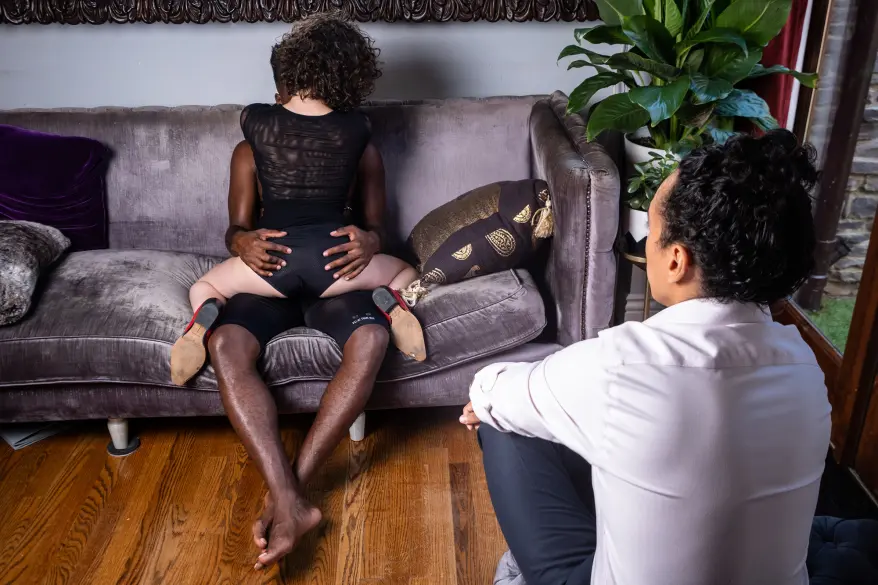
In short, cuck angst is anxiety that arrives fused to arousal, tied to a specific planned event.
Where does the term cuck angst come from?
The term comes from the cuckolding community itself, and its most widely read published use is a Savage Love column dated October 27, 2021, in which Dan Savage answered a 33-year-old woman describing herself as a possible cuckquean. She wrote that she was “vacillating between titillation and anxiety” about her husband’s planned dinner with another woman.
Savage credited the name to Venus, host of the Venus Cuckoldress Podcast, who had given the feeling both a label and a dedicated segment on her show. Venus told him that “to be able to process and overcome damaging jealousy and turn it into something highly erotic is truly an emotional feat,” and that a partner’s reassurance carries much of the weight during it. Savage added that the feeling of “arousal and dread, titillation and anxiety” is common among both aspiring and practicing cuckolds.
Two details in that column are easy to miss and worth keeping. The letter writer was a woman anxious about her husband, so the feeling is not limited to husbands watching wives — it applies equally to the arrangement we describe in our guide to cuckquean and hothusbanding dynamics. And Venus’s practical advice was slowness, not exposure therapy.
Cuck angst is therefore community vocabulary with a traceable origin, coined by a cuckoldress podcaster and popularized through a 2021 advice column.
Why does anxiety feel arousing to some cuckolds?
Anxiety and sexual arousal share most of their physical signature, so the body cannot always tell you which one you are having. Three separate lines of evidence explain the overlap, and they carry different weight.
The first is general psychology. Donald Dutton and Arthur Aron’s 1974 experiments on misattribution of arousal, published in the Journal of Personality and Social Psychology, found that men aroused by a frightening setting were more likely to read that arousal as attraction to the woman who approached them. The study says nothing about cuckolding specifically, but it explains why a racing heart in a tense moment can register as desire.
The second is prevalence data. On October 12, 2020, Kinsey Institute research fellow Justin Lehmiller published a breakdown of his survey of more than 4,000 Americans showing that 52% of heterosexual men, 66% of non-heterosexual men, 26% of heterosexual women and 42% of non-heterosexual women had fantasized about watching a partner with someone else. He also reported that 24% of heterosexual men fantasized about the watching version often, compared with 12% for the version in which they are the one being watched. Numbers at that scale describe a common fantasy, not a rare pathology, which matches what we found in our review of what thousands of cuckolds reported about their own experiences.
The third line is clinical and contested. Giulio Perrotta’s paper “The counterphobic matrix of cuckolding and troilism,” published August 6, 2022, in the International Journal of Sexual and Reproductive Health Care, argues that sharing paraphilias begin with a counterphobic move: the fear of betrayal is converted into an act the person controls, then reinforced until it becomes compulsive. That hypothesis rests on a small set of clinical interviews using one author’s own instruments, and it treats the behavior as a disorder from the outset. Set against it is the study by Justin Lehmiller, David Ley and Dan Savage that CNN reported on January 25, 2018, which found that people who acted on cuckolding fantasies mostly described positive experiences.
Read together, the research supports a simple position: the anxious charge is a normal feature of the fantasy for many people, and pathology language should be reserved for cases where the behavior is compulsive or harmful.
Is cuck angst normal, or a sign something is wrong?
Both, depending on what happens after the date ends. The most reliable test couples describe is the fade test: eroticized angst loosens its grip within a few hours of reconnecting, while distress keeps running on its own schedule.
| Signal | Eroticized angst | Distress that needs a pause |
|---|---|---|
| Duration | Peaks around the event, eases within hours of reconnecting | Persists for days, or returns without a trigger |
| Response to reassurance | Reassurance works and is welcome | Reassurance is doubted, or needed constantly |
| Sleep and appetite | Broadly unchanged | Disrupted sleep, loss of appetite, physical symptoms |
| Behavior | Anticipation, talking, planning | Checking the phone, monitoring, searching for details |
| Direction of desire | Pulls the couple toward each other afterwards | Withdrawal, avoidance, or resentment afterwards |
| Consent | The anxious partner still wants the arrangement | Agreement is being given to keep the peace |
That last row is the one that ends arrangements. If a partner is tolerating the plan rather than choosing it, the problem is no longer emotional management, and it belongs in the territory we set out in our guide to where consent ends and betrayal begins.
Cuck angst that fades after reconnection is ordinary; angst that outlives the date and reshapes daily behavior is a reason to stop and renegotiate.
When does cuckold anxiety hit hardest — before, during, or after?
Most accounts describe three distinct phases, and each one responds to a different intervention. Treating them as one long feeling is why some couples over-correct and cancel the whole arrangement after a rough first attempt.
| Phase | What people describe | What helps |
|---|---|---|
| Anticipation (days before) | Looping thoughts, appetite changes, high arousal mixed with second thoughts | A smaller first step, a firm agreement in writing, and a deadline for changing your mind |
| The waiting window (during) | The hardest hours for most cuckolds: no information, imagination filling the gap | An agreed information level, one scheduled message, and something planned to occupy the time |
| The drop (hours to days after) | Flat mood, tearfulness or irritability after an event that went well | Aftercare, food and sleep, physical contact, and no relationship decisions for 48 hours |
The third phase has a borrowed name. Non-monogamy and kink communities call it drop, and threads in r/nonmonogamy about feeling emotional after a first sharing experience describe it the way BDSM communities describe subdrop: a comedown after intensity, including after a good experience. It is the phase couples plan for least, which is why we wrote a full guide to cuckold aftercare and what to do once the date is over.
Cuckold anxiety is not one event but three, and the waiting window and the drop cause more damage than the date itself.
How do couples reduce cuck angst without removing the charge?
The goal is not zero anxiety. Couples who keep the dynamic alive for years describe reducing uncertainty while leaving the erotic tension intact, and they do it with structure rather than willpower.
- Name it out loud before the date. Saying “I will probably get angst around nine o’clock” removes the shame of it arriving and tells your partner what to expect.
- Set the information level in advance. Agree exactly what gets shared and when: nothing until morning, a single text on arrival, or full detail afterwards. Uncertainty, not information, drives the worst of the waiting window.
- Shrink the first step. A drink in public, an ended-early evening, or a date that stops at conversation gives you real data with a low emotional cost. Venus’s advice in that 2021 column was the same: taking things slow is what works, and stepping backwards after rushing is harder than moving forward slowly.
- Agree a check-in word that works mid-date. One word, no explanation required, no discussion afterwards about whether it was justified. If using it costs a fight, it is not a real option.
- Write the reassurance note. Venus described a wife who wrote her husband a letter to read if the angst became overwhelming during her first encounter. It is a small, concrete tool and it costs nothing to prepare.
- Book the reconnection window. Decide before the date how the evening ends: who comes home when, whether there is contact, and what the first hour together looks like.
- Make no permanent decisions inside 48 hours. Neither “we are stopping forever” nor “let’s book the next one tomorrow” should be settled while either partner is still in the drop.
Couples who start the conversation well tend to manage the feeling better later, which is why the groundwork in how to raise cuckolding with a partner in the first place matters more than any in-the-moment fix. The same is true of the planning habits in our hotwife date night playbook.
Structure lowers uncertainty without lowering the charge, and uncertainty is the part that hurts.
What should couples do when the angst does not fade?
Stop the schedule, not the conversation. A pause is a normal and reversible step, and it is far cheaper than pushing through distress and then repairing the trust afterwards.
Treat these as reasons to pause rather than to persist:
- The anxiety is still running three or four days after the date, with no fresh trigger.
- Sleep, appetite or work performance are affected for more than a few days.
- Reassurance no longer helps, or has to be repeated constantly to have any effect.
- One partner has started monitoring the other’s phone, location or messages.
- Agreement is being given to avoid a fight rather than because it is wanted.
- Alcohol or anything else is being used to get through the evening.
If the pattern repeats, a professional is the right next step, and there is no need to explain the lifestyle from scratch to a stranger. The Kink and Polyamory Aware Professionals directory, run by the National Coalition for Sexual Freedom at kapprofessionals.org, lists therapists, doctors and lawyers who have stated that they work with kink and non-monogamous clients. NCSF notes that it does not screen or endorse the professionals listed, so normal vetting still applies. Certified sex therapists can also be found through the AASECT directory.
Community spaces help with normalizing the feeling, but they are not clinical support, and some are worse than useless — the checks in our guide to choosing a cuckold forum safely apply here. For the wider question of pausing or ending an arrangement, the emotional accounting in our piece on compersion is a useful counterweight: if the pleasant side of the emotion never arrives, the arrangement is not delivering what it promised.
Persistent cuckold anxiety is a signal to pause and get qualified help, not a test of endurance.
What does cuckold media get wrong about cuck angst?
Commercial cuckold content compresses the emotional timeline to almost nothing, and that distortion is where inexperienced couples pick up their expectations. On screen and in caption formats, the anxious moment is the product: it arrives instantly, resolves inside a few minutes, and is usually framed as humiliation.
Real accounts run on a much slower clock. The angst starts days early, peaks in a waiting window nobody films, and ends in an aftercare conversation that has no commercial value. The genre also treats the feeling as a fixed trait — the cuck is anxious because that is what he is — while couples describe it as a state that changes with pacing, information and reassurance.
Format shapes the distortion too. A caption is a single sentence engineered to land the anxious spike with no context and no aftermath, which is exactly the mechanism we examined in why one caption sentence hits harder than a full video. The humiliation framing is a genre convention with its own history, covered in our analysis of cuckold humiliation and modern masculinity, and plenty of people in the lifestyle want none of it.
Creator content is also produced work with editing decisions and a business behind it, a point that comes through clearly in profiles such as our review of Elaina St James’s verified pages. Reading any of it as an instruction manual for your own timeline is the mistake. First-hand accounts are more useful, and what actually happens on a first hotwife date versus what people imagine is a better reference point than any scripted scene.
Commercial content sells the spike and skips the pacing, reassurance and aftercare that make the feeling manageable.
Frequently Asked Questions
No. Jealousy is a protective reaction to a perceived threat, and it can appear in any relationship. Cuck angst is anxiety fused with arousal, attached to an event both partners agreed to in advance. Jealousy can be present inside cuck angst, but the two are not interchangeable.
Most accounts describe it building for a few days before the date, peaking during the hours a partner is out, and easing within a few hours of reconnecting. A flat or irritable mood can follow for a day or two. Anxiety still running after several days is a different problem.
Not by itself. Justin Lehmiller reported in October 2020 that 52% of heterosexual men and 26% of heterosexual women had fantasized about watching a partner with someone else, so the interest is common. Clinical concern applies when the behavior becomes compulsive or causes lasting distress, not because anxiety is present.
Yes. The Savage Love column that popularized the term on October 27, 2021, was answering a woman describing the arousal-and-anxiety mix about her husband meeting another woman. The feeling follows the role, not the gender, and cuckqueans report the same anticipation and waiting-window pattern.
Not automatically. Anxiety every time is common, and for some people it is the point. Stop if the anxiety no longer fades after reconnection, if reassurance stops working, if monitoring behavior starts, or if agreement is being given to avoid conflict rather than because it is wanted.
Cuck angst is the price of admission for many cuckold couples and a stop signal for others, and the difference shows up in what the feeling does after the date rather than during it. If you are still working out which roles and language fit your own arrangement, start with the cuckold section or the broader hotwife lifestyle guides, and read our explainer on what a cuckold relationship is and how common it actually is before planning a first date night.