




Cuckold horns are the centuries-old European symbol of a man whose wife has been unfaithful: to “wear the horns” meant to be a cuckold. English sources have tied horns to cuckoldry since the mid-1400s, and the image survives today in the Italian corna hand gesture, the Russian phrase “наставить рога,” and, in reclaimed form, in the stag and hotwife community.
Key Takeaways
- Cuckold horns are an invisible pair of horns said to grow on a betrayed husband’s head. The Online Etymology Dictionary dates the symbol in English to the mid-15th century.
- No single origin of cuckold horns is proven. The best-supported theory links them to capons, castrated roosters whose cut spurs were grafted onto their combs and grew like horns.
- The horns hand gesture, index and little finger raised, still accuses a man of being a cuckold in Italy, Spain, Portugal, Greece and much of Latin America. Avoid it abroad.
- Early modern England called a husband who knowingly accepted his wife’s affairs a wittol, and mocked him hardest of all, so today’s consensual cuckold is a genuine break with history.
- Modern lifestyle couples have reclaimed the image. Stag husbands take their name from an antlered animal, and hotwife merchandise now uses a horned logo as an insider signal rather than an insult.
Why Does a Centuries-Old Insult Still Matter to Lifestyle Couples?
Cuckold horns matter because they are the oldest piece of vocabulary the modern lifestyle inherited. The word cuckold arrived in English in the early 13th century from an Old French word for the cuckoo, a history I covered in what the word cuck means and how it became an insult. The horns came later and carried a sharper message: everyone can see your shame except you.
The symbol still shows up in online insults aimed at lifestyle couples and in the merchandise couples use as quiet signals. In my four years covering this lifestyle, horns have come up far more often as a joke than as a piece of history.
Cuckold horns are the inherited insult the modern cuckold and stag community has had to answer, which is why understanding their history has practical value.
What Do Cuckold Horns Mean?
Cuckold horns mean that a man’s wife has had sex with someone else, usually without his knowledge. The horns were imagined as invisible, fixed to the husband’s forehead, and obvious to the whole community while he remained unaware of them. To “horn” someone, as a verb, meant to cuckold him. The Online Etymology Dictionary records that sense of the verb from the 1540s.
The insult worked on two levels: betrayal, and a supposed failure of manhood, since a husband was expected to control and satisfy his wife. A 2022 University of Melbourne essay by history graduate Joseph Moorhead quotes a 1708 edition of the British Apollo making the point bluntly: husband and wife are one flesh, but the husband is the head, so he must wear the horns.
In plain terms, cuckold horns marked a husband as betrayed and publicly humiliated, and the blame landed on him rather than on the wife or her lover.
Where Did the Cuckold Horns Symbol Come From?
The origin of cuckold horns is disputed, and scholars treat most popular explanations as guesses. Oxford etymologist Anatoly Liberman wrote on the OUPblog in May 2018 that none of the evidence he had seen predates the Middle Ages, and he warned that the more ingenious an explanation sounds, the more likely it is wrong. The table below grades the main theories by the strength of their evidence.
| Theory | What it claims | Evidence | How strong? |
|---|---|---|---|
| Capon grafting | Farmers cut the spurs from castrated roosters and grafted them onto the comb, where they grew like horns. The German word Hahnrei (“cuckold”) first meant capon. | Linguist Hermann Dunger argued it in 1884; Liberman called it convincing in 2018. Graber and Richter debated it in the Journal of American Folklore in 1987. | Strongest |
| The defeated stag | A stag that loses a fight during the rut forfeits his mates to the winner, yet still carries his antlers. | Cited by Wikipedia’s “Cuckold” entry as the source of the allusion. | Plausible |
| Unseen horns | A horned animal cannot see its own horns, just as a husband is often the last to know. | Reported by BBC News in July 2009 as “a more common explanation.” | Folk explanation |
| Actaeon | In Greek myth, the hunter Actaeon was turned into a stag, so he became “horned.” | Alluded to in Shakespeare’s The Merry Wives of Windsor and Burton’s The Anatomy of Melancholy. | Literary, not causal |
| Roman soldiers | Legionaries returned home with horns as war trophies and found unfaithful wives. | Repeated by BBC News in 2009; Liberman dismissed it as fanciful. | Weak |
| German war helmets, a 1427 decree, a Byzantine emperor | Various stories about horned helmets, soldiers punished with horns, and Emperor Andronikos Komnenos (1183 to 1185) hanging antlers on the gates of men whose wives he seduced. | Listed as competing versions by the Russian reference site Gramota.ru. | Anecdotal |
The capon theory is the most persuasive because it explains a real linguistic link: the German word for a cuckold grew out of the word for a castrated rooster.
The best-supported answer is that cuckold horns began as a comparison to capons with grafted spurs, but no theory has been proven.
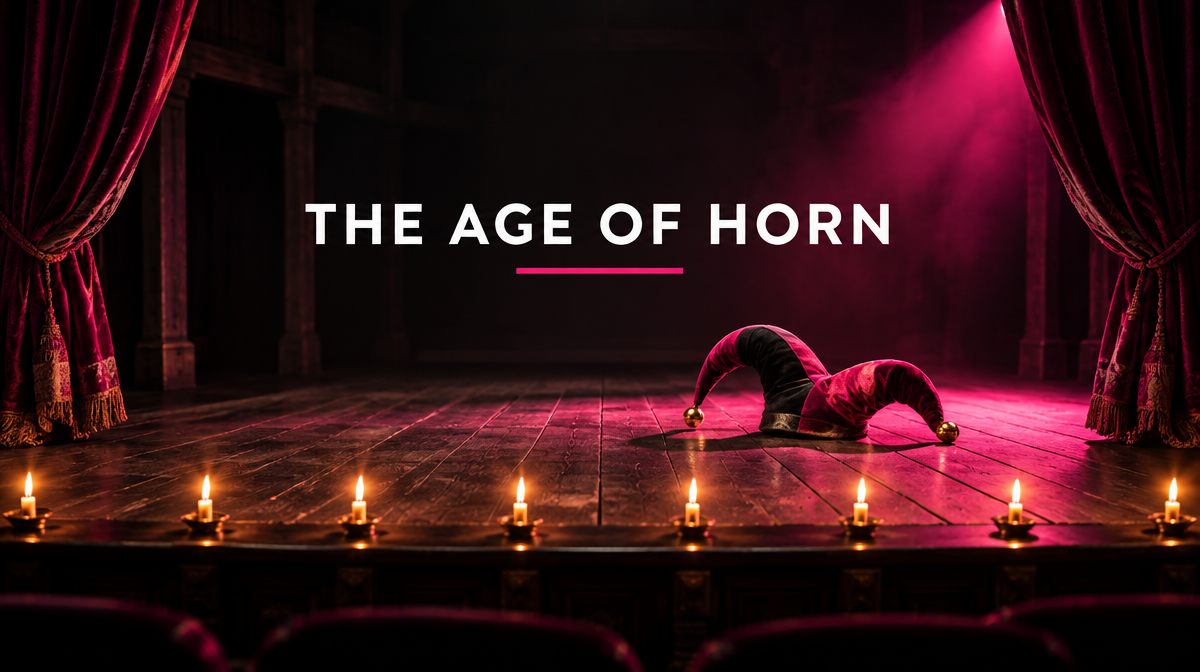
Why Were Cuckold Horns Everywhere in Shakespeare’s England?
Cuckold horns became a staple of comedy in 16th- and 17th-century England, and Moorhead argues the period “ought to be called the ‘age of horn.’” Ballads, almanacs, and plays treated the horned husband as a stock figure. Shakespeare used the image constantly, both for laughs and for tragedy.
In Othello, the title character, convinced his wife is unfaithful, says “A horned man’s a monster and a beast” (Act 4, Scene 1, line 62). In As You Like It, a hunting song tells men to “Take thou no scorn to wear the horn,” treating cuckoldry as a common fate that joins men together. In Much Ado About Nothing, marriage itself is described as a fraternity “tipped with horn.” Robert Burton warned in The Anatomy of Melancholy that a lusty wife “will surely graft horns on thy head.”
The symbol also lived outside literature. Moorhead’s essay documents three examples:
- Horn Fair, a real annual carnival in Charlton, near London, famous for its rowdiness.
- Cuckold’s Point, a spot on the Thames that drew tourists and served as a punchline in ballads.
- The Bull-Feathers Hall Society, a late-17th-century London club whose members wore feathers as horns and met twice a week to laugh at cuckoldry together.
A 1661 treatise titled Horn Exalted went further and argued that horns could stand for honor as well as disgrace. That ambiguity is the seed of everything that came later.
In early modern England, cuckold horns were simultaneously a source of shame, a running joke, and a strange kind of brotherhood among men.
What Was a Wittol, and Why Does It Matter to Modern Cuckolds?
A wittol was a husband who knew about his wife’s affairs and accepted them, and early modern culture treated him as the most contemptible cuckold of all. Moorhead cites a 1609 insult aimed at a man named William Dynes: his horns were said to be so large that he could barely fit through his own door. The unaware cuckold was pitied. The consenting one was despised.
The satirical Poor Robin almanac of 1699 ranked cuckolds by type and declared the “Loving Cuckold” best, but even that ranking assumed the husband was a victim making the best of it.
What history never had was a category for a husband who consents because he wants the arrangement, and whose wife wants it too. That is the modern lifestyle cuckold. The practice now has its own clinical vocabulary, from candaulism and its origins to compersion, the emotion that makes cuckolding work. In the community-run 2026 Cuckold Survey, published in May 2026, 68.2% of respondents said their fantasy centers on the wife’s pleasure rather than their own, which describes desire, not defeat. Consent is also what separates the lifestyle from betrayal, a line I drew in detail in is hotwifing cheating.
The wittol shows that the consenting husband was once the most mocked figure in the culture, which is exactly the figure the modern cuckold community set out to redefine.
How Do Other Languages Talk About Cuckold Horns?
Cuckold horns appear across most European languages, which is one reason the symbol feels universal to readers in Russia and the wider CIS region. Wikipedia’s “Cuckold” entry and Russian reference sources record the following expressions.
| Language | Expression | Literal meaning |
|---|---|---|
| Russian | наставить рога (nastavit roga); рогоносец (rogonosets) | “to put horns on” someone; “horn-bearer” |
| English | to wear the horns; horned | to be a cuckold |
| Italian | cornuto; corna | “horned [one]”; “horns,” also the name of the hand gesture |
| French | porter des cornes | “to wear horns” |
| German | Hörner aufsetzen; Hörner tragen; der gehörnte Ehemann | “to put horns on”; “to wear horns”; “the horned husband” |
| Portuguese | corno | “horned [one]” |
| Spanish | cornudo | “horned [one]” |
| Greek | κερατάς (keratas) | “horned [one]” |
Gramota.ru, a leading Russian language reference, defines “наставить рога” as a wife deceiving her husband, a phrase also applied to the wife’s lover, and notes that the expression exists in many European languages while its origin remains disputed. Wikipedia’s “Sign of the horns” entry adds that the everyday words for a cuckolded man in Greek, Italian, Spanish and Portuguese all literally mean “horned one.”
The horn image is shared across Russian, English, Greek, Romance and Germanic languages, and in every one of them it signals a betrayed partner.

What Does the Horns Hand Gesture Mean?
The horns hand gesture, with the index and little finger raised, means “your wife is cheating on you” in much of the Mediterranean and Latin world. Wikipedia’s “Sign of the horns” entry lists Colombia, Greece, Italy, Portugal, Spain and Mexico among the countries where it is offensive. In Italy it is called the corna, and the insult that goes with it is cornuto.
The gesture has caused real diplomatic trouble. In February 2002, during a group photograph at an informal EU summit in Spain, Italian prime minister Silvio Berlusconi raised two fingers behind the head of Spanish foreign minister Josep Piqué, which Reuters described in 2023 as “the traditional Latin gesture for a cuckold.” In July 2009, Portuguese economy minister Manuel Pinho made a horns gesture at an opposition MP during a parliamentary debate and was replaced soon afterward, BBC News reported. The same BBC report noted that in the Caucasus any “you have horns” gesture is considered gravely offensive.
The same hand shape means something else entirely in other settings:
- In heavy metal culture, Ronnie James Dio popularized it as a sign of approval.
- At the University of Texas at Austin, it is the “Hook ’em Horns” school salute.
- In Italian folk tradition, a horned-hand amulet, the mano cornuta, is worn to ward off the evil eye, according to the Pitt Rivers Museum at the University of Oxford.
The horns gesture is a friendly salute in some places and a serious cuckold insult in others, so lifestyle couples traveling abroad should not use it casually.
Is “Horny” Related to Cuckold Horns?
No, “horny” and cuckold horns come from the same animal word but developed separately. The Online Etymology Dictionary dates the cuckold sense of “horn” to the mid-1400s. The sense of “horny” meaning lustful appears in print by 1889, and perhaps as early as 1863, and it grew out of a late-18th-century slang phrase, “to have the horn,” which referred to male arousal.
“Horny” and “horned” share a root but not a meaning: one is about desire, the other about betrayal.
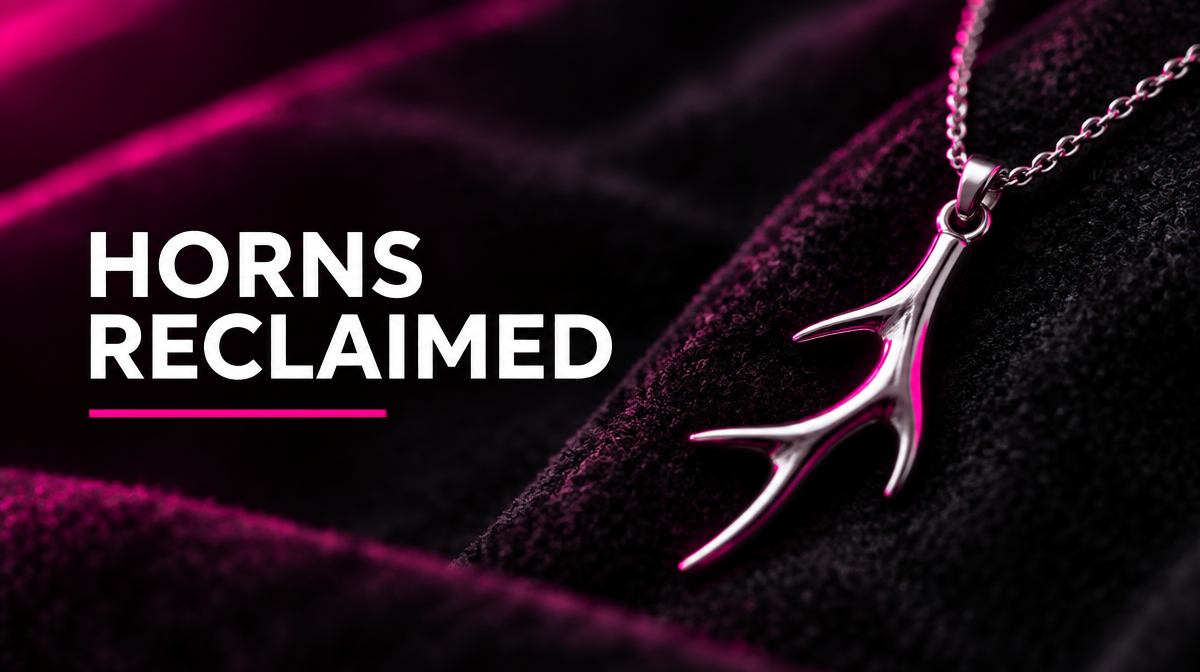
How Does the Lifestyle Community Use Horns Today?
The modern lifestyle community has turned cuckold horns from an insult into an identity marker. The clearest example is the word stag. A stag, in current usage, is a husband who enjoys his wife’s freedom with other men and is secure rather than submissive, a role I compared in stag vs cuckold vs bull. The irony is hard to miss: the community named its proudest husband after the antlered animal that Wikipedia identifies as the source of “wearing the horns.”
The reclamation has reached merchandise. As of September 2026, one of the best-known hotwife blogs sells a “Hotwife Horns” line of hats, mugs, tote bags and shirts built around a horned letter O. Etsy listings also include antler-design pendants and fox charms marketed as stag and vixen jewelry. These items sit alongside older signals such as the Queen of Spades symbol, the upside-down pineapple, and anklets and thumb rings.
If you plan to use horn imagery, three practical rules apply:
1. Know your audience. To insiders a horned logo reads as pride. To outsiders, especially in Southern Europe, Latin America, or the Caucasus, it reads as an accusation. 2. Keep gestures off camera. A horns gesture in a vacation photo can be read as mockery of the man beside you, and it can identify you to people who know the code. 3. Treat symbols as disclosure. Any lifestyle signal can out you to colleagues or family, so weigh it the way you would weigh any other privacy decision for lifestyle couples.
Today’s lifestyle couples use horns as a knowing badge, but the symbol still carries its old sting for anyone outside the community.
Saying a man wears horns means his wife or partner has been unfaithful to him. The phrase comes from the European image of invisible horns growing on a betrayed husband’s head, a symbol recorded in English since the mid-15th century. In modern lifestyle circles, the same image can be used playfully by couples who share by choice.
Nobody knows for certain. The best-supported theory, argued by linguist Hermann Dunger in 1884, links horns to capons, castrated roosters whose cut spurs were grafted onto their combs and grew like horns. Other explanations point to stags that lose their mates during the rut, or to the idea that a horned animal cannot see its own horns.
In Italy, the horns hand sign, called the corna, tells a man that his wife is cheating on him and pairs with the insult cornuto. It is a real insult, and Silvio Berlusconi caused a diplomatic incident by making it behind a Spanish minister in 2002. Worn as an amulet, the same shape is meant to ward off the evil eye.
The Russian phrase “наставить рога,” meaning to cheat on a spouse, has disputed origins. Gramota.ru lists four versions: ancient Germanic wives placing horned helmets on departing husbands, the myth of Actaeon turned into a stag, a 1427 German decree punishing soldiers with horns, and a Byzantine emperor who hung antlers on deceived husbands’ gates.
Inside the hotwife and stag community, horn imagery is usually read as a playful badge of a consensual arrangement, and some lifestyle retailers sell horn-themed merchandise. Outside the community it remains an insult, especially in Mediterranean and Latin American countries. Use it where its meaning is shared, and avoid the hand gesture with strangers or abroad.
The Bottom Line
Cuckold horns began as a medieval mark of a betrayed and humiliated husband, and the consensual lifestyle has turned them into a symbol of a husband who chose the arrangement. The history explains why the insult still stings and why reclaiming it means something. If you are new to the vocabulary, start with the difference between hotwifing and cuckolding, then read about the cuckquean, the same dynamic with the genders reversed.
Cuckold horns went from a public shaming device to an insider’s badge, and the difference between the two is consent.
Sources
- Online Etymology Dictionary — “horn (n.)” and “horny (adj.),” accessed September 23, 2026. https://www.etymonline.com/word/horn
- Anatoly Liberman, OUPblog — “Etymology gleanings: May 2018,” May 2018. https://blog.oup.com/2018/05/etymology-gleanings-may-2018/
- Robert Bates Graber and Gregory C. Richter — “The Capon Theory of the Cuckold’s Horns: Confirmation or Conjecture?” Journal of American Folklore 100, no. 395, 1987. https://www.jstor.org/stable/539989
- Joseph Moorhead, University of Melbourne SHAPS Forum — “Cuckoldry in Early Modern England,” September 19, 2022. https://blogs.unimelb.edu.au/shaps-research/2022/09/19/cuckoldry-in-early-modern-england/
- Wikipedia — “Cuckold” (section “Horns and the rut”), accessed September 23, 2026. https://en.wikipedia.org/wiki/Cuckold
- Wikipedia — “Sign of the horns,” accessed September 23, 2026. https://en.wikipedia.org/wiki/Sign_of_the_horns
- Janet Williams, BBC News — “Cuckolds, horns and other explanations,” July 4, 2009. http://news.bbc.co.uk/2/hi/europe/8133615.stm
- Reuters — “Silvio Berlusconi’s memorable quotes and quips,” June 12, 2023. https://www.reuters.com/world/europe/silvio-berlusconis-gaffes-quips-quotes-2023-06-12/
- Gramota.ru — “Наставить рога,” Russian phraseology reference, accessed September 23, 2026. https://gramota.ru/biblioteka/spravochniki/spravochnik-po-frazeologii/nastavit-roga
- Wiktionary — “Hahnrei,” accessed September 23, 2026. https://en.wiktionary.org/wiki/Hahnrei
- Shakespeare Navigators, Eastern Washington University — Othello, Act 4, Scene 1 summary. https://shakespeare-navigators.ewu.edu/othello/S41.html
- Pitt Rivers Museum, University of Oxford — “Small Blessings: Horned Hand, Corsica.” https://web.prm.ox.ac.uk/amulets/index.php/protection-2/
- Etsy — “Stag Vixen Necklace” marketplace listings, accessed September 23, 2026. https://www.etsy.com/market/stag_vixen_necklace
- Happy Hotwife shop — “Hotwife Horns” product line, accessed September 23, 2026. https://happyhotwife.com/shop/