




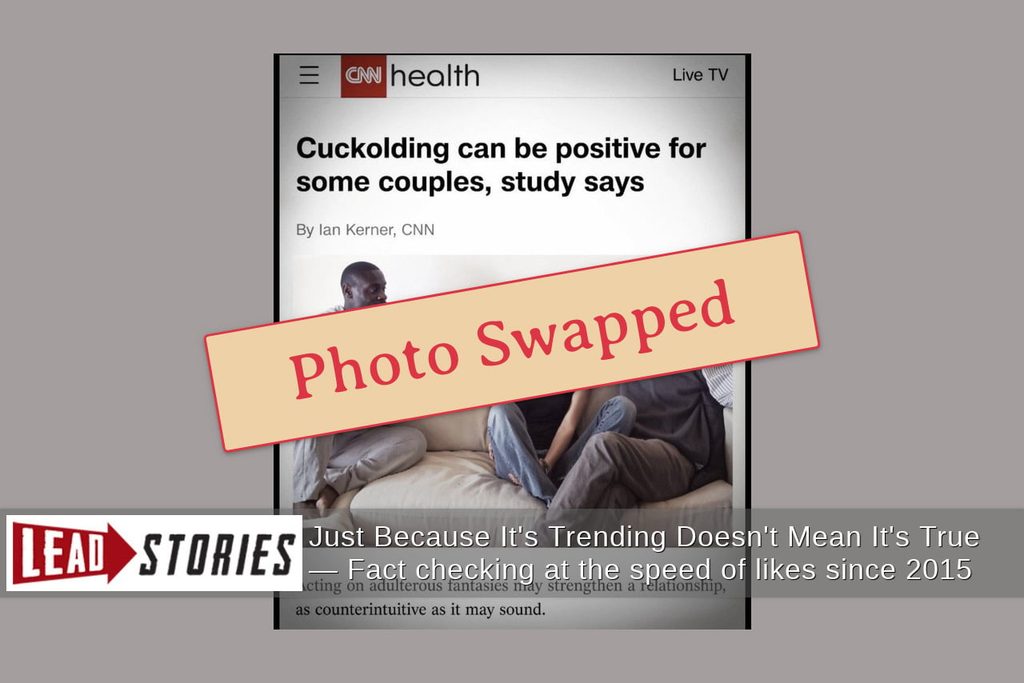
The CNN cuckolding article is real: Ian Kerner’s “Cuckolding can be positive for some couples, study says” ran on CNN Health on January 25, 2018. The screenshot that spread on X in late September 2026 is not, because someone replaced CNN’s original photo with an image of a white couple and a Black man, which the fact-checking site Lead Stories confirmed on September 25, 2026.
One swapped picture changed what the story appears to say. I have covered cuckold culture for four years, and I have rarely seen a cleaner example of how an image can rewrite a piece of sex research without touching a word of it.
Key Takeaways
- The CNN cuckolding headline is genuine and dates to January 25, 2018; only the photo in the viral September 2026 screenshot was replaced, according to a Lead Stories fact-check published September 25, 2026.
- The study behind the headline surveyed 580 mostly gay-identified men, and its authors reported that interracial themes were less common in that group than in earlier research on heterosexual men.
- The positive findings were conditional. Lehmiller told CNN that relationship anxiety, weak communication and poor planning predicted worse experiences, so the research never claimed cuckolding helps every couple.
- Before you share a screenshot of a news story, search the headline on the outlet’s own site, compare it with an archived copy, and run the image through a reverse image search.
What Did the Viral CNN Cuckolding Screenshot Show?
The viral image showed CNN’s real 2018 headline above a photo that CNN never published. According to Lead Stories, the post appeared on X on September 24, 2026, and paired the headline “Cuckolding can be positive for some couples, study says” with a picture of a white couple and a Black man sitting on a sofa.
CNN’s actual photo is very different. It shows three white people walking together, seen from behind, and the caption credits Shutterstock. Lead Stories checked both the live CNN page and a Wayback Machine copy captured on January 25, 2018, and found the same three-person image in each. The fact-checkers labeled the screenshot “Photo Swapped.”
The headline, byline and date in the screenshot were accurate. Only the picture was false, and that is what made the fake persuasive: a reader who searches the headline finds a real CNN article and assumes the rest of the image checks out too.
In one sentence: the viral screenshot pairs a real headline with a fake photo, and the photo carries the message.
What Did the 2018 CNN Cuckolding Article Actually Say?
The 2018 CNN cuckolding article was a short health column, not a scandal story. Kerner, a licensed psychotherapist and sexuality counselor in New York City, summarized a new study by psychologist David Ley, social psychologist Justin Lehmiller and writer Dan Savage, and framed it against the rise of “cuck” as an alt-right insult.
Its main claims were measured. Kerner wrote that acting on cuckolding fantasies “can be a largely positive experience for many couples.” He cited Lehmiller’s then-forthcoming book Tell Me What You Want for the figure that 58% of men and about a third of women had fantasized about cuckolding, and noted that references to cuckolding in literature go back to the 13th century.
The caveats were as prominent as the headline. Lehmiller told CNN that people with “a lot of relationship anxiety or abandonment issues,” people who lack intimacy and communication, and people who are not careful planners could have a negative experience. “Not everyone who has a cuckolding fantasy should think about acting on it,” he said.
Ley added a warning I wish every curious husband would read. He said he had seen men try to trick their wives into cuckolding, and “this never, ever ends up well.”
| Element | Viral screenshot (Sept 2026) | CNN article (Jan 25, 2018) | Journal study (Dec 28, 2017) |
|---|---|---|---|
| Headline | Real CNN headline | “Cuckolding can be positive for some couples, study says” | “The Psychology of Gay Men’s Cuckolding Fantasies” |
| Photo | White couple and a Black man on a sofa | Three white people walking, seen from behind (Shutterstock) | None; academic paper |
| Who was studied | Implies a heterosexual interracial couple | A study of 580 gay men, plus Lehmiller’s general survey figures | 580 predominantly gay-identified men |
| Race | Interracial framing is the focus | Interracial themes described as less common among gay men | Interracial and BDSM themes less common than in prior research on heterosexual men |
| Caveats | None visible | Anxiety, poor communication and poor planning predict bad outcomes | Positive outcomes depend on personality and attachment style |
Read side by side, the CNN article is a cautious summary, while the screenshot strips out every qualifier.
What Did the Cuckolding Study Behind the Headline Find?
The study CNN covered is “The Psychology of Gay Men’s Cuckolding Fantasies,” by Justin Lehmiller, David Ley and Dan Savage. Archives of Sexual Behavior published it online on December 28, 2017 and printed it in the May 2018 issue (volume 47, pages 999-1013). The authors surveyed 580 predominantly gay-identified men about their cuckolding fantasies and experiences.
Their abstract reports four main findings:
- Gay men’s cuckolding fantasies shared many elements with heterosexual men’s fantasies but differed in important ways.
- Interracial and BDSM themes appeared less common in gay men’s fantasies than in earlier research on heterosexual men.
- Frequent cuckolding fantasies overlapped with interests such as voyeurism and group sex, and they were linked to traits including agreeableness, sensation seeking and sociosexuality.
- Gay men who acted on the fantasy tended to report positive experiences, but the likelihood of a good outcome depended on personality and attachment style.
Lehmiller later published a breakdown from the 4,175-person survey behind Tell Me What You Want. In an October 12, 2020 post on his Sex and Psychology blog, he reported that 52% of heterosexual men and 66% of non-heterosexual men had fantasized about watching a partner with someone else, along with 26% of heterosexual women and 42% of non-heterosexual women. CNN’s 58% figure for men appeared before that split by orientation was published, so the numbers describe different groups and should not be compared directly.
The research supports a narrow claim: the fantasy is common, and acting on it can go well for couples with the emotional footing to handle it.
Why Was a Black Man Swapped Into the Photo?
The swap draws on an online trope that ties the word “cuck” to race. Linguist Maureen Kosse, writing in the journal Gender and Language in 2022, argued that far-right users connect “cuck” to the “great replacement” conspiracy theory, and that the link comes from “the imagery provided by interracial cuck pornography.” Put plainly, the insult borrows its picture from a porn genre.
That connection was visible years earlier. In an August 3, 2015 column for Salon, Joan Walsh reported that the far-right insult “cuckservative” apparently came from a genre in which a white husband watches his wife with a Black man. In January 2018, Gizmodo noted that alt-right memes regularly used Black men as the visual punchline of the insult. I traced how an old word for a betrayed husband became a political slur in our history of the cuck insult.
What makes the 2026 fake revealing is its mismatch with the science. The study behind the headline was about mostly gay men, and its authors specifically reported that interracial themes were less common in their sample. The doctored photo adds the one element the research played down, then presents it as the core of the story. That is not a misreading of a study. It is a substitution.
The cost lands on real people. Black men in the lifestyle already describe being treated as a fantasy category rather than as individuals, a pattern I examined in how race actually works in interracial swinging. Some couples do hold a genuine preference: in the 2026 cuckold survey, 35.1% of respondents named a Black bull specifically, while 44.5% said they had no preference.
A preference held with respect is one thing. A meme that turns every Black man into a political prop is another, and our guide to respect and racial stereotypes in mature hotwife BBC dynamics explains where that line sits.
The photo swap works because it imports a racist meme into a real headline, not because it reflects what the research found.
Why Does the 2018 CNN Article Keep Coming Back?
The CNN column has become a recurring culture-war object, and the 2026 fake is at least its second major cycle. The first began on publication day. Gizmodo reported in January 2018 that Infowars editor-at-large Paul Joseph Watson shared a screenshot of the article, and the Daily Caller wrote on January 25, 2018 that CNN “is willing to encourage any sexual practice, no matter how depraved.”
David Ley answered on Twitter the same day, suggesting that conservative scorn for cuckolding “masks a whole lot of hidden fantasy and desire.” He told Gizmodo that Lehmiller’s forthcoming data showed as many as 58% of men endorsed a fantasy of watching a female partner with other men.
Both cycles share a mechanism: a screenshot travels without the article attached. In 2018 the screenshot was genuine but detached from its caveats. In 2026 the screenshot itself was altered. My read is that the headline makes ideal bait because it combines a mainstream news brand, a taboo word and the word “positive,” and a reader can react to all three without opening the link.
A headline that has worked as bait twice will likely be used again, so expect this screenshot to resurface with new edits.
What Does a Swapped Photo Mean for the People in It?
A swapped photo can attach a sexual story to people who never agreed to be part of it. Lead Stories did not identify where the substitute image came from, so nobody should assume who the three people on the sofa are. The general rules for commercial photography still show why the question matters.
Getty Images’ license requires a disclaimer such as “Stock photo. Posed by model.” when an image of a model appears next to a subject a reasonable person would find unflattering or controversial. Shutterstock’s help center says images of recognizable people may not be used in defamatory, offensive or immoral contexts or in ads for dating services, and that none of its images may appear alongside pornographic content. CNN’s original image showed three people from behind, which makes it hard to identify anyone.
The same risk applies to private couples. Photos shared inside a lifestyle group, on a dating profile or with one trusted partner can be cropped, recaptioned and reposted with a new story attached. Our digital privacy guide for hotwife and swinger couples covers how to limit that exposure, and our Elaina St James review shows how quickly fake versions of a real person spread once an image leaves its original context.
Anyone pictured in a recaptioned image has had a story assigned to them without consent, whether they are stock models or a real couple.
How Can You Check a News Screenshot Before You Share It?
Most news screenshots can be checked in under five minutes with free tools. Here is the routine I use before quoting any viral claim about the lifestyle:
1. Search the exact headline on the outlet’s own website. If the article exists, compare its photo, byline and date with the screenshot. 2. Check the publication date. A January 2018 headline presented as news in September 2026 is already misleading before any edits. 3. Open an archived copy. The Internet Archive’s Wayback Machine shows a page as it looked on a specific date, which is how Lead Stories confirmed CNN’s original photo. 4. Run the image through a reverse image search. Google Lens and TinEye show where else a photo has appeared and whether it predates the story. 5. Search Google’s Fact Check Explorer. The tool lets you look up existing fact-checks by keyword, by image URL or by uploading an image. 6. Read the study abstract, not only the headline. The cuckolding study’s abstract is public and shows in one paragraph who was surveyed and what conditions applied. 7. Ask what the image adds. If the picture introduces something the text never mentions, such as race, age or a specific person, treat that addition as the claim to verify.
A screenshot is a claim about an article, not the article itself, so check the source before you react to the picture.
What Should Lifestyle Couples Take From the CNN Story?
The useful part of the 2018 article is its advice, and it holds up. Ley and Lehmiller both stressed honesty, communication, mutual interest and careful planning, which matches what couples tell me after their first real experience. If a partner sends you the viral screenshot as a joke or a test balloon, the genuine article makes a better conversation opener than the meme, because it includes the warnings.
For couples starting that conversation, how to bring up cuckolding with your partner walks through what works. Savage told CNN that the reality “is often very different than the fantasy” and can bring up powerful emotions, which is the ground our cuck angst explainer covers in detail. If the emotional upside is what draws you in, compersion in cuckolding explains the feeling many couples describe when it goes well.
Vocabulary matters as well. CNN used “cuckolding” broadly, while the community separates roles such as stag, cuckold and bull, and our breakdown of stag vs cuckold vs bull explains the differences.
The real lesson of the CNN story is the one the meme deletes: the fantasy is common, and acting on it works best for secure, communicative couples who move slowly.
Frequently Asked Questions
Yes. CNN published “Cuckolding can be positive for some couples, study says” by Ian Kerner on January 25, 2018, and it remains on CNN’s website. The version that circulated on X in September 2026 used the real headline but replaced the original photo, as Lead Stories confirmed on September 25, 2026.
The original CNN article used a Shutterstock photo of three white people walking together, shown from behind. Lead Stories compared the live page with a Wayback Machine copy from January 25, 2018 and found the same image in both. The viral screenshot instead showed a white couple and a Black man on a sofa.
No. The article said acting on cuckolding fantasies can be positive for many couples, and it quoted Justin Lehmiller warning that relationship anxiety, abandonment issues, poor communication and weak planning can make the experience negative. He told CNN that not everyone with the fantasy should act on it.
Justin Lehmiller, David Ley and Dan Savage wrote “The Psychology of Gay Men’s Cuckolding Fantasies,” which Archives of Sexual Behavior published online on December 28, 2017. The study surveyed 580 predominantly gay-identified men and found that positive outcomes depended on personality and attachment style.
Researchers trace the racial meaning to far-right meme culture. Linguist Maureen Kosse argued in Gender and Language in 2022 that alt-right users connect “cuck” to the great replacement conspiracy theory through imagery borrowed from interracial pornography. The swapped CNN photo relied on the same visual shorthand.
What Is the Bottom Line on the CNN Cuckolding Screenshot?
The CNN cuckolding article is a real 2018 column about a real study, and the September 2026 screenshot is a doctored version that swapped in a racialized photo the research never supported. The fantasy itself is far older than any news cycle, as the history of the cuckold horns and the story of King Candaules both show. The fastest way to misunderstand it is through a screenshot, so read the source, check the image, and keep the caveats attached.
Sources
- Lead Stories — “Fact Check: FAKE Screenshot Swaps Photo Of Real CNN Article ‘Cuckolding Can Be Positive For Some Couples’,” September 25, 2026. https://leadstories.com/hoax-alert/2026/09/fact-check-fake-photo-used-real-cnn-article-cuckolding-positive-some-couples.html
- CNN — Ian Kerner, “Cuckolding can be positive for some couples, study says,” published January 25, 2018, updated March 9, 2018. https://www.cnn.com/2018/01/25/health/cuckolding-sex-kerner
- Internet Archive — Wayback Machine capture of the CNN article, January 25, 2018. https://web.archive.org/web/20180125094254/http://www.cnn.com/2018/01/25/health/cuckolding-sex-kerner/
- Lehmiller, J. J., Ley, D., and Savage, D. — “The Psychology of Gay Men’s Cuckolding Fantasies,” Archives of Sexual Behavior 47, 999-1013; published online December 28, 2017. https://link.springer.com/article/10.1007/s10508-017-1096-0
- Justin Lehmiller — “How Many Women Fantasize About Cuckolding?” Sex and Psychology, October 12, 2020. https://www.sexandpsychology.com/blog/2020/10/12/how-many-women-fantasize-about-cuckolding/
- Maureen Kosse — “‘Ted Cruz cucks again’: The insult term cuck as an alt-right masculinist signifier,” Gender and Language, 2022; summarized by CU Boulder College of Arts and Sciences Magazine, March 16, 2023. https://www.colorado.edu/asmagazine/2023/03/16/what-does-ted-cruz-cucks-again-actually-mean
- Salon — Joan Walsh, “The GOP crack-up continues: The raging civil war over the disgusting ‘cuckservative’ slur,” August 3, 2015. https://www.salon.com/2015/08/03/the_gop_crack_up_continues_the_raging_civil_war_over_the_disgusting_%E2%80%9Ccuckservative%E2%80%9D_slur/
- Gizmodo — “Sex Researcher Thinks Many ‘Cuck’-Obsessed Conservatives Harbor Private Cuckoldry Fantasies,” January 26, 2018. https://gizmodo.com/sex-researcher-thinks-many-cuck-obsessed-conservatives-1822422097
- The Daily Caller — report on the CNN cuckolding column, January 25, 2018. https://dailycaller.com/2018/01/25/cnn-cuckolding-positive/
- Getty Images — Content License Agreement, restricted uses: “No Sensitive Use Without Disclaimer.” https://www.gettyimages.com/eula
- Shutterstock Help Center — “Can I use Images for sensitive subjects?” August 19, 2025. https://www.shutterstock.com/help/en/articles/10616973-can-i-use-images-for-sensitive-subjects
- Internet Archive Help Center — “Using the Wayback Machine.” https://help.archive.org/help/using-the-wayback-machine/
- Google — Fact Check Tools, “About: Can I search by image?” https://toolbox.google.com/factcheck/about
- TinEye — Reverse Image Search. https://tineye.com/